

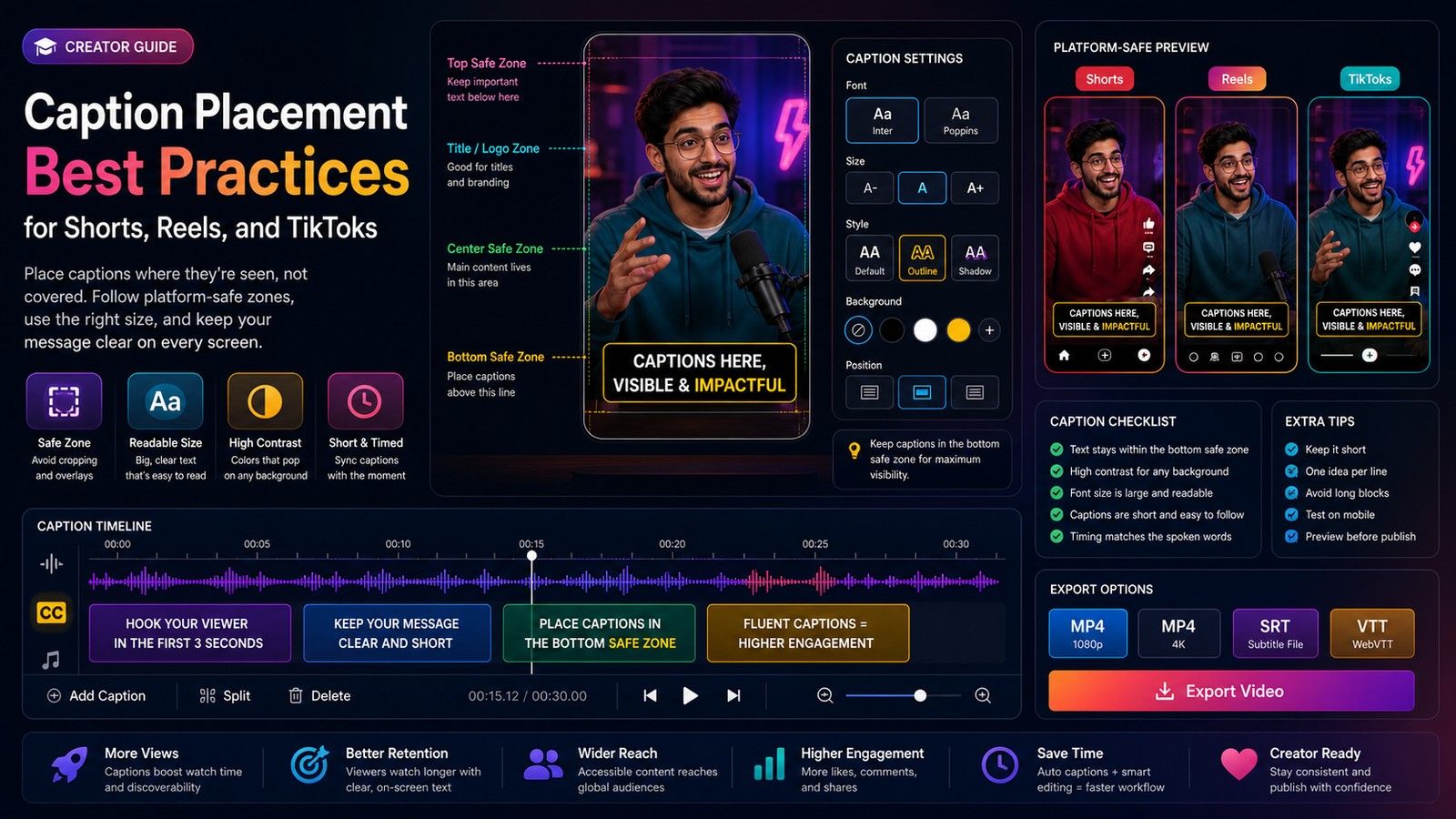
Caption Placement Best Practices for Shorts, Reels, and TikToks matters because creators are publishing more videos across more platforms, but viewers are giving each clip less time to prove its value. When captions are clear, searchable, and styled for mobile, a viewer can understand the hook before they turn the sound on. That is the practical advantage of caption placement best practices: it makes content easier to watch, easier to reuse, and easier to discover.
This guide is written for Short-form creators, editors, and agencies. It follows the same creator-first workflow we recommend inside CapsAI: start with the source video, generate a reliable transcript, turn that transcript into captions, edit the details that affect trust, and publish versions that match the platform. The goal is not to add subtitles as decoration. The goal is to make every video easier to consume, search, translate, and repurpose.
You will see references to subtitle placement, safe zone captions, short video captions throughout the guide because those topics are connected. A caption workflow is rarely just one button. It includes audio quality, transcript cleanup, caption placement, export format, localization, repurposing, and performance review.
Quick Answer
The fastest way to handle caption placement best practices is to upload or paste the video into an AI caption workflow, generate captions automatically, review names and technical terms, style the subtitles for mobile, then export the final video or caption file. CapsAI is built for that workflow because creators often need captions, transcripts, clips, and downloader tools in one place.
Why It Matters
For search, captions also create structure. A clean transcript can clarify the topic of a video, support better descriptions, improve repurposing, and make it easier to transform one recording into social clips, summaries, blog drafts, and email content. That is why caption placement best practices should be treated as a publishing system rather than a last-minute edit.
Best Practices
Keep subtitles readable before they are stylish. A bold font, strong contrast, and safe-zone placement usually outperform complicated animations. If viewers must work to read a caption, the caption is failing its job. This is especially important for caption placement best practices, where the viewer may be learning a workflow, comparing tools, or watching in a second language.
Real Creator Use Cases
A YouTube educator can use caption placement best practices to caption tutorials, export an SRT file, and reuse the transcript as a lesson summary. The same workflow helps viewers who pause, skim, or revisit steps without replaying the full video.
FAQ Section
The FAQ section below covers practical questions creators ask about caption placement best practices, including setup, accuracy, editing, exports, accessibility, and platform-specific publishing.