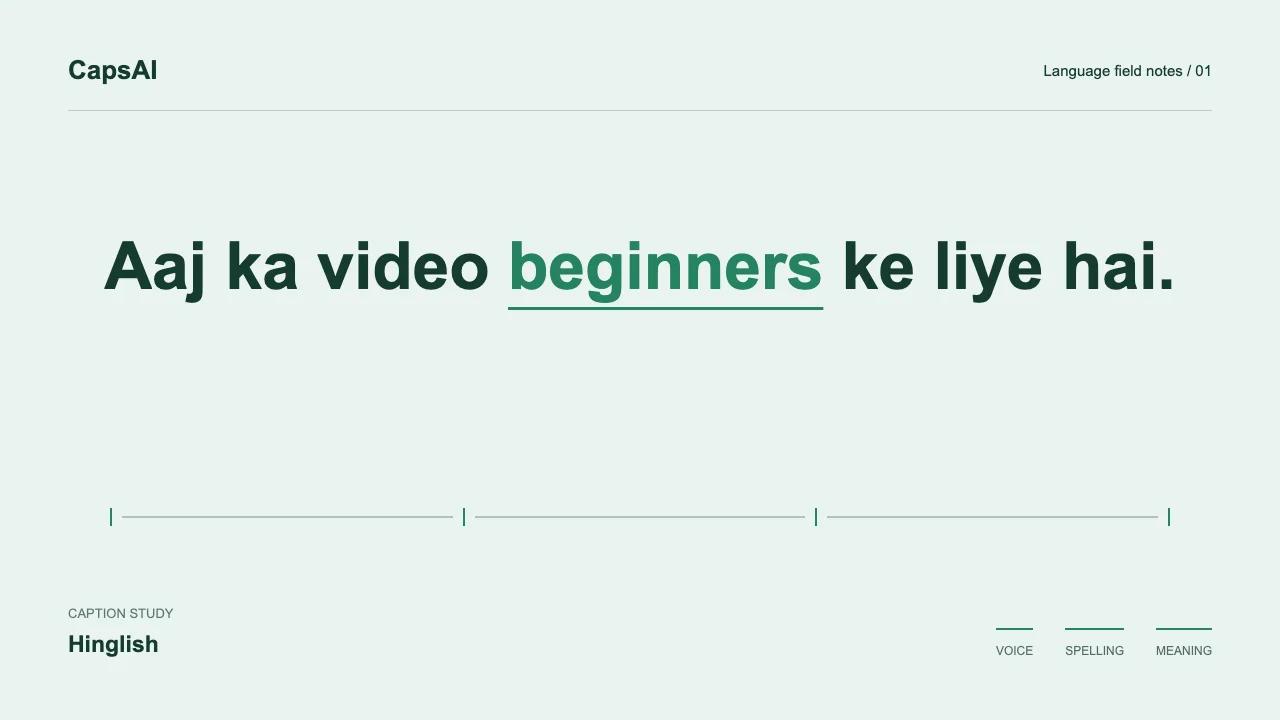


What Hinglish actually is
Hinglish is the fluid mix of Hindi and English spoken across India - in conversations, in boardrooms, on YouTube, and in WhatsApp messages. It's not random language mixing. Speakers follow intuitive grammatical patterns when switching between Hindi and English within a sentence.
A creator saying 'Basically ye feature bohot powerful hai, I use it daily' is making deliberate choices: English for the technical term, Hindi for emphasis, English again for the personal habit. Accurate captions preserve those choices rather than flattening them.
Why Hinglish is hard to caption
Three overlapping problems make Hinglish difficult for automated captioning: script ambiguity (Hindi words need Romanization), language boundaries (mid-sentence switches confuse monolingual models), and spelling variation (no standardized Latin spelling for Hindi words).
A draft can substitute similar-sounding words or translate a phrase that should stay bilingual. Compare the result with the recording rather than judging accuracy only by whether the sentence looks grammatical.
Meaning checks for a generated Hinglish draft
Keep negatives and quantities
If the audio says 'Ye free nahi hai', a draft reading 'Ye free hai' reverses the meaning. Restore 'nahi' before styling the caption. Similarly, compare prices, dates, and quantities with the audio instead of accepting a plausible-looking number.
Distinguish spelling choices from different words
You can choose a consistent spelling such as 'pehle' rather than 'pahle'. But 'hai' and 'hain' are not interchangeable spelling variants: listen for the word actually spoken. Use the complete sentence to resolve ambiguous words such as Hindi 'main' and English 'main'.
Hindi speech with English words
Iska notification settings mein jaake change karo.Ye meeting reschedule karni padegi unfortunately.See natural Hinglish captions on your video
Upload your video and generate captions that preserve your Hindi-English speech patterns.
English speech with Hindi words
The problem is, yaar, nobody checks the document.We should launch this, pakka, before the deadline.Romanized Hindi in captions
Most Hinglish captions use Latin script - Hindi words are written phonetically in English letters. There's no single standard: 'nahin' and 'nahi', 'kuch' and 'kuchh' are all used. What matters is consistency within a piece of content.
Choose spellings that your audience recognizes and use them consistently. For example, decide whether your captions use 'accha' or 'achcha'; do not alternate without a reason.
Code-switching patterns
Code-switching in Hinglish follows patterns. Speakers tend to switch to English for technical terms, brand names, and internet-era vocabulary. They tend to stay in Hindi for emotional emphasis, cultural references, and colloquial expressions.
Good Hinglish captions reflect these patterns. When a speaker deliberately chooses a Hindi word over an available English equivalent, the caption should preserve that choice. The switch is part of the meaning.
Common Hinglish caption mistakes
Literal translation instead of transcription
Hinglish captions should transcribe what was said, not translate it. If the speaker says 'Mujhe lagta hai this is a good idea', the caption should preserve the Hindi opening - not replace it with 'I think this is a good idea'. Translation removes the bilingual quality.
Inconsistent Romanization
Writing 'pehle' in one caption and 'pahle' two seconds later makes the viewer work harder. Pick a spelling convention and stick with it. The convention doesn't need to be academically correct - it needs to be consistent and recognizable.
Removing Hindi filler words
Words like 'yaar', 'na', 'accha', and 'haan' carry tone and relationship context. Stripping them produces captions that are technically accurate but emotionally flat. Keep fillers that contribute to the speaker's voice; remove only repetitive disfluencies.
Over-correcting grammar
Hinglish has its own grammar. 'Main yesterday meeting attend kiya' is natural Hinglish - don't correct it to standard English or standard Hindi. The captions should match the speech, not an idealized version of either language.
How creators can make Hinglish captions more readable
After generating captions, do one full review for consistency. Check that the same Hindi words are spelled the same way throughout. Verify proper nouns - the model might render a brand name as a similar-sounding Hindi word or vice versa.
Break long sentences at natural speech pauses, not at arbitrary character limits. Hinglish sentences often have a Hindi clause followed by an English one - the language switch point is usually a natural break point for captions too.